Noonee — Chairless Chair Travel Case
Client snapshot
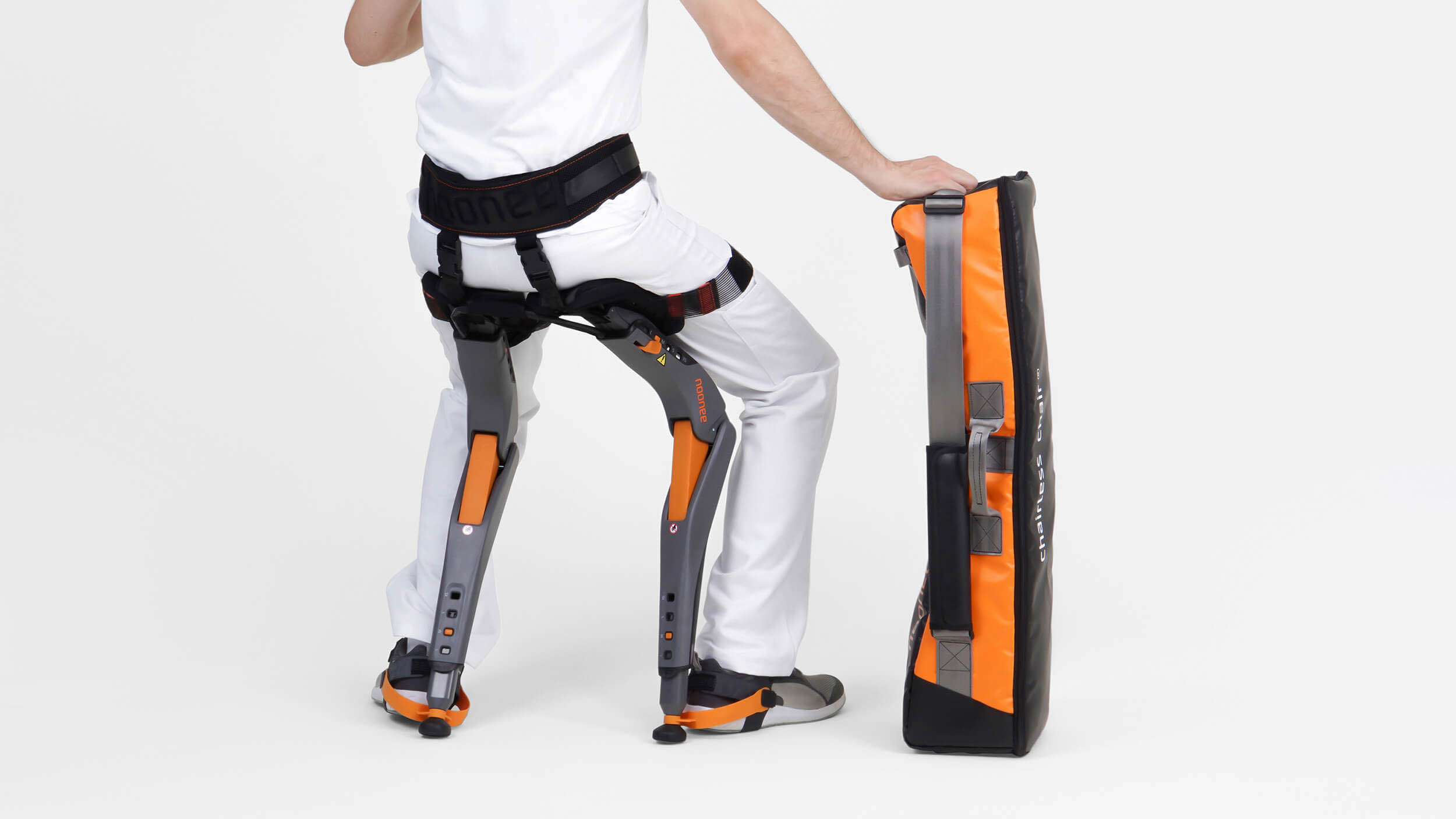
Noonee is a Swiss startup behind the Chairless Chair, a wearable exoskeleton that lets industrial workers sit wherever they are, without a chair. Worn on the legs, it lets operators on production lines and assembly stations rest in a supported sitting position whenever they need to, then walk away as normal. The goal is to reduce the physical strain of long hours on their feet.
When Noonee approached Forward AP, it was still a small company. Almost all of its people and resources went into developing and engineering the exoskeleton itself, and there was little capacity for anything around it. Yet the business depended on one activity that happened entirely outside the lab: putting the product in front of clients.
A wearable device like the Chairless Chair is hard to sell from a brochure. Clients need to see it, handle it, and ideally have their own workers try it on. For Noonee's sales team, that meant travelling to client sites and meetings in person, and each sales rep typically carried two or three exoskeletons per trip. How the product travelled had become a real constraint on how the company sold.
The challenge
Until then, Noonee's sales team had been transporting the exoskeletons in cardboard boxes. The box protected the product well enough, but it created a series of problems, most of them caused by its size.
The main issue was air travel. A rigid box large enough for the Chairless Chair was far too big to be accepted as cabin baggage, so every trip meant checking the product in as oversized luggage. That brought extra handling, extra time at check-in and at the oversized baggage belt, and the constant risk of a precision device being knocked around, delayed or lost before a client demonstration. For a sales trip built entirely around showing the product, arriving without it, or with it damaged, was not an option.
There was also the question of presentation. A worn cardboard box carried into a client meeting does little to convey a high-tech engineered product. The first thing a client saw before the demo even started was packaging that looked improvised.
During the project, the team identified a key opportunity. Although the exoskeleton is a large item, airlines will allow it on board as a cabin item, in much the same way they accept a guitar, provided it is carried in a slim, flexible bag rather than a rigid box. The constraint was not the product; it was the container. If the bag could be designed to meet that condition, the Chairless Chair could travel in the cabin with the rep, and every trip would become simpler.
That turned the brief into a precise set of requirements:
- A slim, flexible bag that would meet airline expectations for carrying the exoskeleton on board
- A shape that follows the product closely, with no wasted volume
- Secure fixing of the exoskeleton inside the bag, so it cannot shift in transit
- Protection for the frame, joints and components throughout handling and travel
- Space for the rep's documentation, plus extra belts and straps for the demonstration
- The lowest possible weight, since reps often travelled with more than one unit
- Materials robust enough for both travel and industrial environments, and easy to clean
- Colours and branding matched exactly to Noonee's identity
Because Noonee's team was fully committed to engineering the product, the company needed a partner that could take the bag from brief to finished product with minimal input from its side.
The solution
The core idea was simple: rather than putting the exoskeleton into a generic container, design the bag around the exoskeleton. Every part of the case follows from the shape of the Chairless Chair and from the way the sales team uses it.
A bag shaped to the product
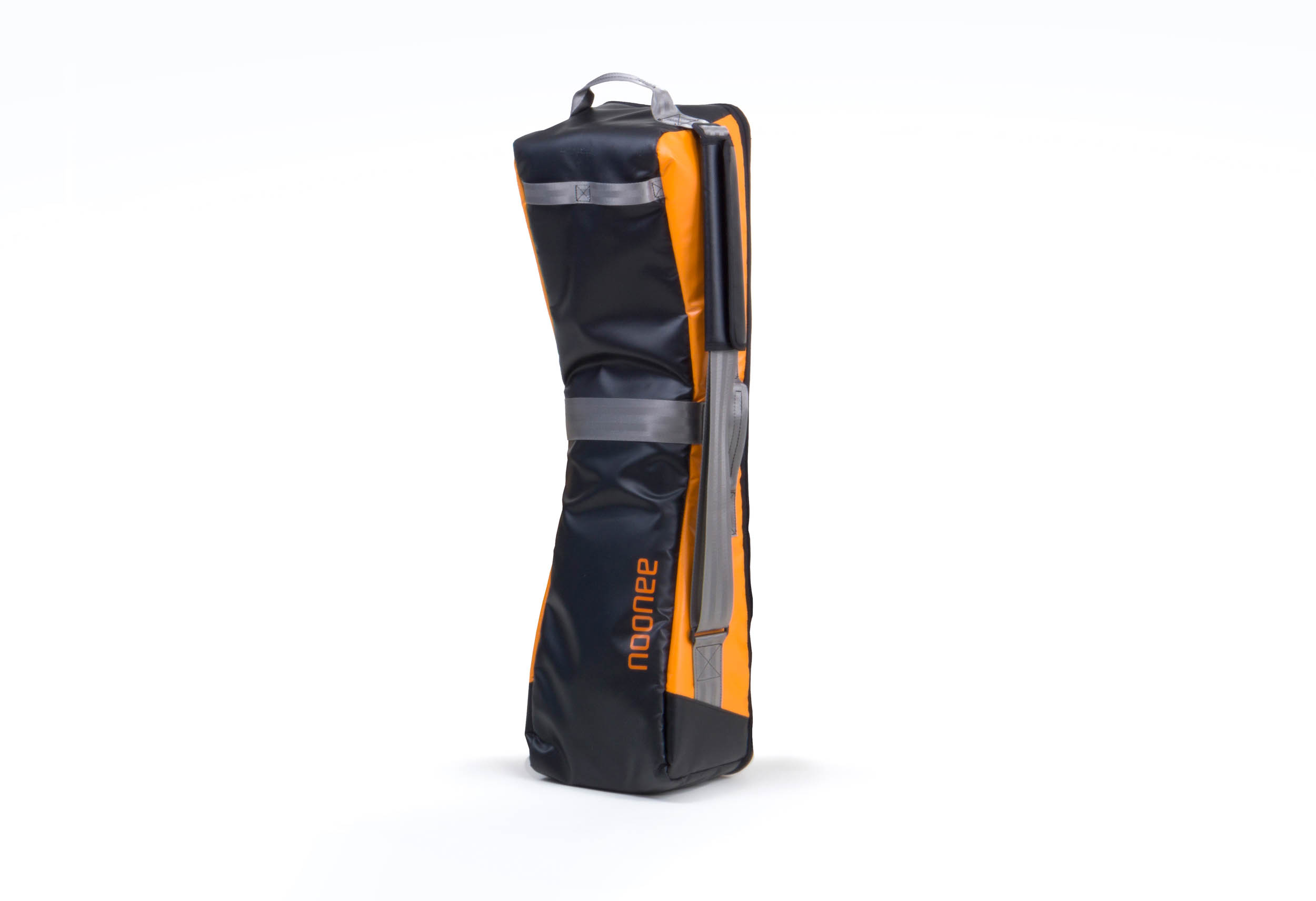
The bag's profile follows the outline of the exoskeleton. Its base is curved to match the form of the item, so the product sits naturally in the bag instead of being forced into a rectangular space. This keeps the overall volume to a minimum, which was essential for getting the bag accepted on board and for making it easy to carry through airports, taxis and client sites.
Side reinforcements give the bag structure where the product needs protection, without turning it into a rigid case. The bag holds its shape and shields the exoskeleton, but stays slim and flexible enough to meet the condition that allows it in the cabin.
Secure fixing, with room to flex
Inside, each side of the exoskeleton is held in place with Velcro straps. Once secured, the product cannot slide or knock against itself during travel, which protects the joints and mechanical components that matter most during a demonstration. Straps also make loading and unloading quick, so a rep can take the exoskeleton out, demonstrate it, and pack it away again without fuss.
The centre of the bag is deliberately narrow. This lets the exoskeleton, and the bag with it, bend when needed, for example to fit into overhead storage or into the space available on board. Flexibility here is not a compromise but a feature: it is what makes the bag practical as a cabin item, while the reinforced sides keep the product protected.
Everything the rep needs, in one bag
The flat section of the bag carries a series of pockets for the documentation the sales team takes to meetings, along with the extra belts and straps used to fit and demonstrate the exoskeleton. Rather than juggling a box, a separate document bag and loose accessories, the rep arrives with one bag that holds the product and everything needed to present it.
Light, tough and easy to clean
Weight was one of the strictest constraints. A rep carrying two or three units feels every extra gram, so the bag had to be as light as possible. At the same time, it had to survive both air travel and industrial settings, where it might be set down on a factory floor, brushed against machinery or handled by several people during a visit.
Forward AP selected a TPU-coated polyester to balance these demands. The material is light, resistant to abrasion and the knocks of regular travel, and protects the contents from dirt and moisture. Its smooth, coated surface is also easy to wipe clean, so the bag still looks presentable after a day on a production floor.
A bag that carries the brand
The bag was also designed as a brand ambassador. Its colours match Noonee's Pantone references exactly, and several logos and branding elements are placed across the bag so the identity is visible from different angles.
The aim was for the bag to read as part of the product rather than an accessory to it. When a sales rep walks into a client meeting, the first thing the client sees is a purpose-built, branded case that reflects Noonee's values and aesthetic: engineered, considered and professional. The presentation begins before the bag is even opened.
Development without the burden
Throughout the project, Forward AP handled the design, material selection and manufacturing, allowing Noonee's team to stay focused on the exoskeleton. The bag was developed around the real product and the real routines of the sales team, so the result fitted how reps actually travelled and worked rather than an abstract specification.
Outcome
The new bag changed how Noonee's sales team travelled with its product. With a slim, flexible case shaped to the exoskeleton, the Chairless Chair could go on board as a cabin item, travelling with the rep instead of in the hold as oversized luggage. The product stayed in the rep's hands from departure to the client's door.
That removed many of the frustrations of the cardboard box: the oversized check-in, the waiting at the baggage belt, and the risk of the product being damaged or delayed before a demonstration. Secure fixing and reinforced sides protected the exoskeleton's frame and components, so it arrived ready to demonstrate.
The bag also improved the sales experience itself. Documentation, belts and straps travelled in the same bag as the product, so reps arrived organised and with everything they needed. In meetings, the branded case presented Noonee as the company it is: a technology developer with a carefully engineered product, rather than a startup carrying its prototype in a box.
For Noonee's small team, the project delivered a professional, purpose-built solution without drawing resources away from engineering. A practical travel problem became an asset, with a bag that protects the product, simplifies travel and carries the brand into every client meeting.
Key features
- Slim, flexible construction that allows the exoskeleton to be carried on board as a cabin item, not as oversized freight
- Profile shaped to the exoskeleton, with a curved base that follows the form of the product
- Side reinforcements that protect the frame and components while keeping the bag flexible
- Velcro straps securing each side of the exoskeleton, so it cannot move in transit
- Narrow centre that lets the exoskeleton and bag bend when space requires it
- Pockets in the flat section for documentation and extra belts and straps
- Lightweight TPU-coated polyester, durable in travel and industrial environments and easy to clean
- Colours matched to Noonee's Pantone references, with branding visible across the bag