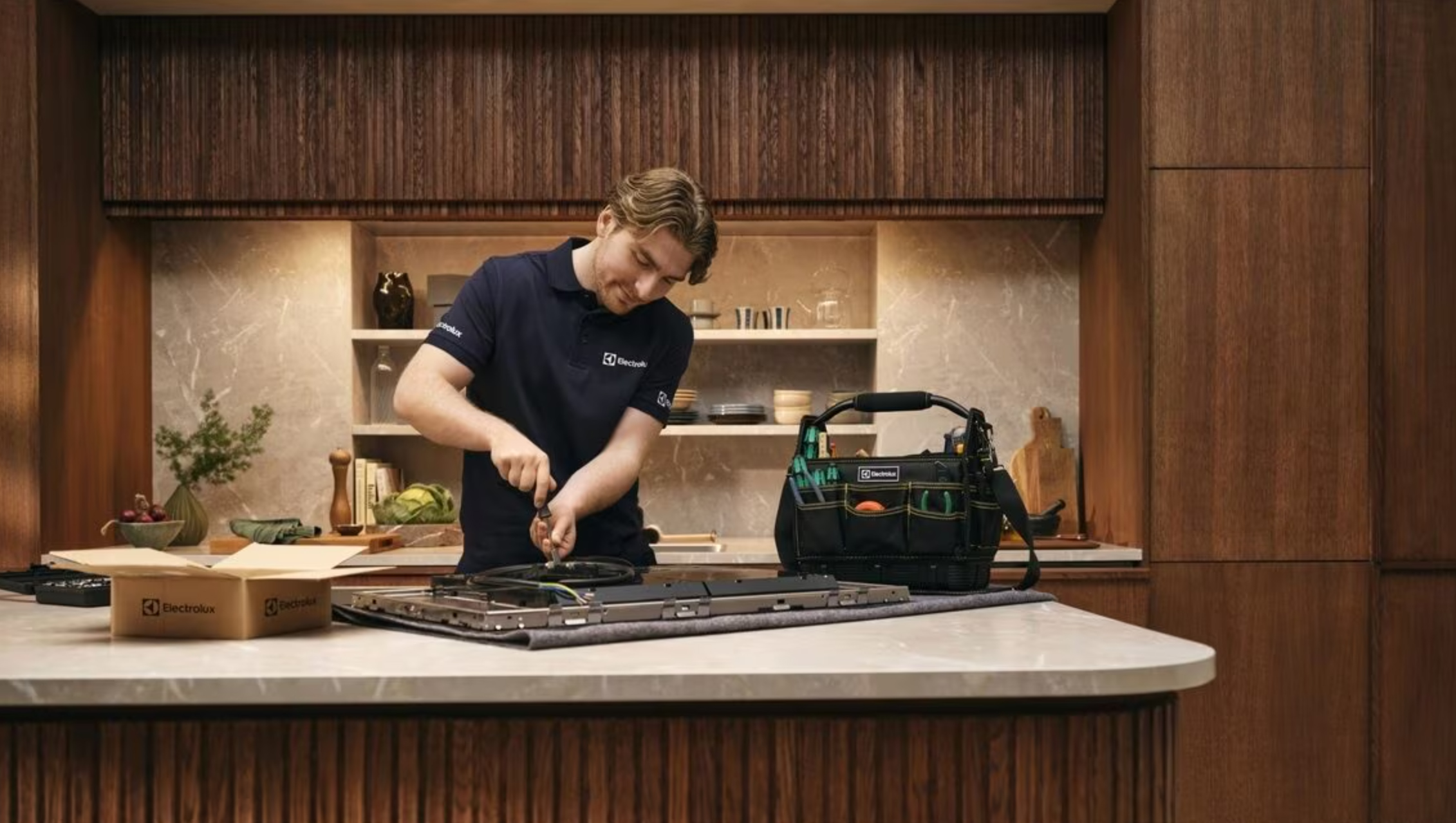
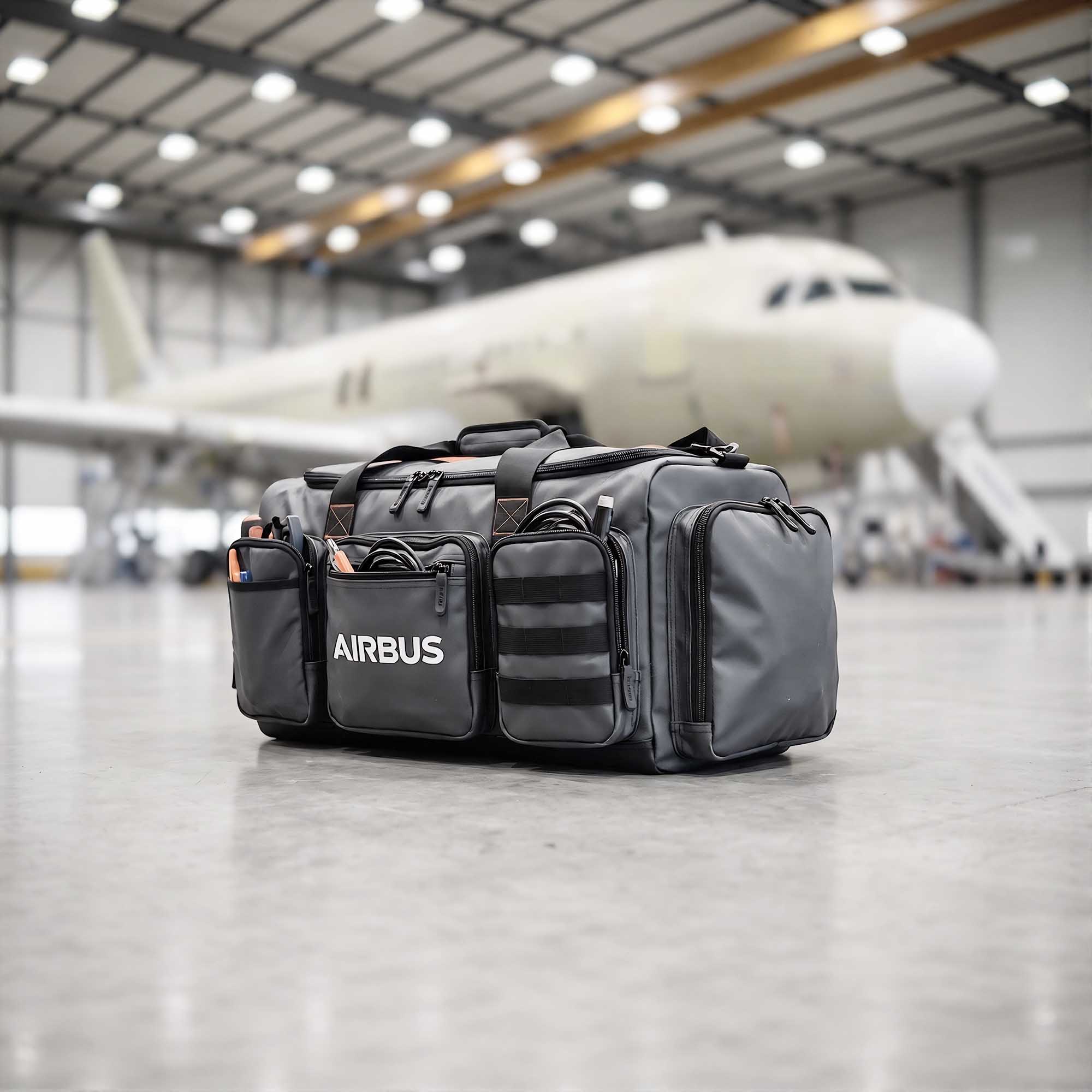
Appliance service, aviation maintenance, and elevator repair have little in common on the surface. But look at how a technician from each sector is actually equipped, and a shared pattern emerges — one that's reshaping how large field-service organizations think about the bag as a piece of corporate equipment, not just a tool container.
The bag format is converging on the backpack.
Across appliance service, MRO, and elevator maintenance, the single-shoulder tote and rigid toolbox are steadily losing ground to structured backpacks. The reason is simple: these technicians climb stairs, work ladders, move through confined mechanical rooms, and walk long distances between calls or aircraft. A backpack keeps both hands free and distributes 15–20 kg of tools and diagnostic equipment across the shoulders and hips instead of one arm. What's changed recently is the internal engineering — rigid, protected compartments for meters and tablets built into a soft-structure shell, rather than a single open cavity.
How they're used has split into two layers.
Most technicians now run a "daily carry" bag holding the tools used on the large majority of calls, backed by a separate, less-frequently-accessed kit — a van store or specialty case — for the rarer job. The daily bag is optimized purely for speed and access: labeled compartments, tool-specific pockets, and zippers that open cleanly with gloves on. That distinction matters for sourcing, because it means one company rarely needs a single "do everything" bag — it needs a well-designed daily unit paired with a simpler secondary case.
Accountability is becoming a design requirement, not a preference.
This is most visible in aviation, where a single misplaced tool inside an aircraft is classified as Foreign Object Debris — an industry-wide risk estimated at billions of dollars in damage annually. That's pushed MRO operators toward shadow-foam tool boards, itemized pouches, and increasingly RFID-tagged kits where every tool has a fixed place and a check-in, check-out record. Elevator and escalator maintenance carries a lighter version of the same logic: a dropped tool in a shaft or motor room is a safety incident, not just a lost item. Even appliance service, far lower-stakes, is trending the same direction — technicians and their employers report that a visibly organized bag builds customer trust before a repair even starts.
Standardization is replacing the "bring your own tools" model.
For years, many field technicians supplied and organized their own bags. Large service organizations are increasingly moving away from that — issuing a uniform, company-specified bag across the whole technician fleet instead of tolerating whatever a mix of individually purchased totes and backpacks happens to be. It simplifies training, inspection, and tool-control audits, and — not incidentally — it puts company branding in front of the customer at every visit instead of a random third-party logo.
What sourcing teams are actually asking for.
Across these sectors, the brief has converged on a consistent set of priorities: rugged, abrasion-resistant fabric (heavy-denier nylon or ballistic weaves) that survives daily field abuse; ergonomic, load-distributing structure for stairs, ladders, and long walking routes; purpose-built, labeled compartments over generic pockets; and branding integrated into the design rather than added as an afterthought patch.
That last point is where a lot of off-the-shelf tool bags fall short — they're built for individual tradespeople, not for a corporate fleet that needs consistent construction, consistent branding, and a supplier who can scale from a pilot batch to thousands of units without the design drifting. That's the gap ForwardAP works in: purpose-built, branded technician bags designed around the actual job, not adapted from a retail tool-bag catalogue.